
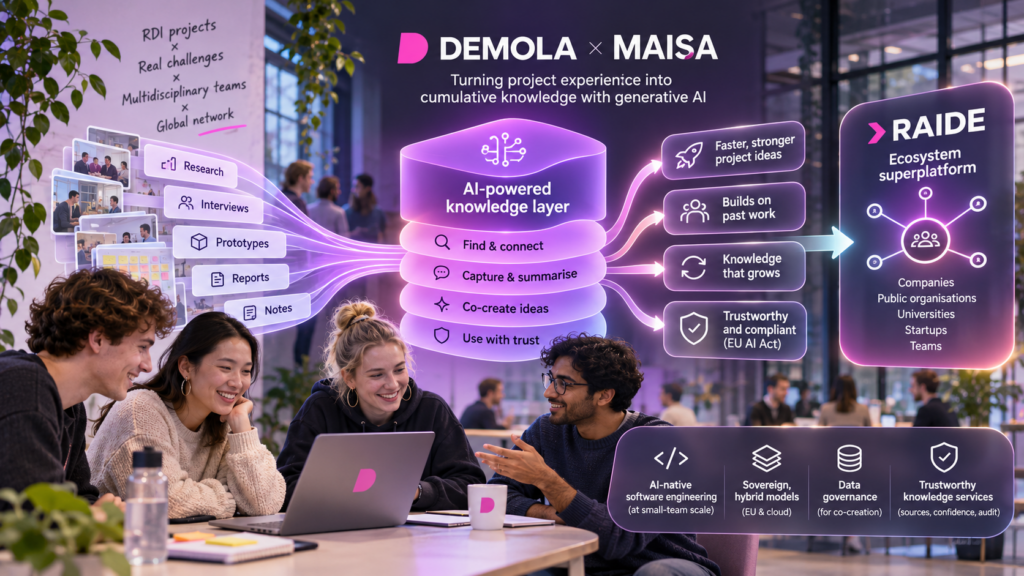
A continuous flow of RDI projects runs on the Demola platform, as teams around the world work on real projects set by companies, universities and public organisations. Each project is carefully documented, but its insights have mostly stayed with that project. In the MAISA research project, Demola explored how generative AI can turn this accumulated material into knowledge that builds on itself, and what that changes for the partners and teams who use it.
Knowledge that didn’t build on itself
Demola brings companies, universities and multidisciplinary teams together to work on open challenges. New projects start continuously, in Finland and across Demola’s network around the world.
Every project produced something valuable: research, interviews, prototypes, final reports and the notes of the people who guided the work. Yet each new project still began from scratch. Insights lived in individual reports, email threads and people’s heads. A partner opening a new challenge could rarely draw on what earlier teams had already discovered on a related topic.
This is a familiar problem for any organisation that runs many projects. The knowledge is there, but it doesn’t add up to more than the sum of its parts.
An unusual partner in a software consortium
MAISA (Managed AI-powered Software Innovations) is a Business Finland co-innovation project that studies how software organisations adopt generative AI. It brings together Tampere University’s GPT-Lab, LUT University, the University of Oulu and companies such as Bittium, Tietoevry, Eficode and KONE, within DIMECC’s SW4E software ecosystem.
Most companies in the consortium build software. Demola is different: it is an innovation platform. That gave Demola’s sub-project its own research question. Could generative AI guide the innovation process itself and turn a decade of project material into a connected knowledge asset that keeps growing? And what kind of software would make that possible?
“What makes Demola valuable for MAISA is that it looks at AI through the innovation process rather than the software development value stream. If AI can help an innovation platform turn past projects into reusable knowledge, the same questions of structure, ownership and trust apply to any organisation that runs many projects,” says Sebastian Sonntag, who steers MAISA for Tampere University’s GPT-Lab.
What changed for partners and teams
Over 2025 and 2026, Demola built and piloted a set of new capabilities in its own operating environment. Together they change how knowledge flows through an innovation project.
Past work is easy to find and connect. Years of team deliverables, staff notes and project data now sit in one knowledge layer. AI summarises and tags the material, so a new challenge can start from what earlier teams have already learned rather than from a blank page.
Knowledge is captured where it happens. Staff and teams can record a meeting and get an AI summary straight into their workflow. Decisions, open questions and paths not taken stay visible after a project ends.
Partners reach strong project ideas faster. Draft projects with built-in partner feedback loops helped prepare dozens of project ideas for partners in RAIDE, Demola’s cross-industry RDI platform for applied AI. Ideas are refined together with partners before any team starts work.
Trust is built in from the start. AI assistants can only access knowledge within each person’s permissions, and every change they propose needs human approval. Audit trails, impact assessments and clear labelling of AI-generated content have been part of the pilot from day one, in line with the EU AI Act.
“The biggest change is not a single tool but how we work. Every meeting and every project now adds to a shared memory, so we no longer start from a blank page. We have also stopped writing long requirement documents. We build a prototype, test it with real people and real data, and improve it as we go. And we have learned that people adopt AI when it clearly saves them effort, not when they are told to use it,” says Ville Kairamo, CEO of Demola Global.
A software engineering case at small-company scale
Behind these pilots lies the question MAISA studies across the consortium: how to build and deploy AI-powered software that is both useful and trustworthy. Demola’s answer came down to a few engineering choices. Instead of training its own models, the team built a well-governed knowledge layer and connected existing models to it through an open standard, the Model Context Protocol (MCP). This means the same knowledge can be used both in Demola’s own tools and in the AI assistants people already use. Trust is part of the architecture itself: access rights are enforced in the software, changes proposed by AI wait for a person to confirm them, and audit trails record what happens.
The software was also built in a new way. A small team works with AI coding agents that write most of the code, while people review, decide and steer. Demola shares these experiences with the consortium as practitioner cases on data readiness, requirements for European AI models and EU AI Act compliance.
What we learned
Some of the most valuable lessons were ones we didn’t expect.
Technology was not the bottleneck. Data quality and everyday adoption determined how much value the tools delivered. Tools prove their worth only when they save people real effort.
Connecting beats customising. We set aside plans to train our own models. Connecting existing models to well-governed knowledge proved more valuable and easier to maintain.
Sovereignty has become a requirement. Partners increasingly ask where their data lives and which models handle it. European data sovereignty has moved from a nice-to-have to a market expectation.
Where it leads: towards an ecosystem superplatform
MAISA built and validated the knowledge and governance layer inside Demola’s own platform. Working on it also changed how we see the next step. The aim is no longer a better tool for one organisation, but an ecosystem superplatform: a shared, AI-native environment where companies, public organisations, universities, startups and university teams co-create across many ecosystems at once, with AI handling much of the coordination.
Its value comes from connecting what each party brings. The right people, earlier results and new opportunities surface from the data instead of being pieced together one challenge at a time. This only works if access to data is granted, not taken: every partner must trust that their confidential material creates value for them without reaching anyone else on the platform.
RAIDE is where that journey begins. RAIDE (Radical AI Deployment Ecosystem) consists of a cross-industry RDI platform, where founding partners, universities and startups co-create applied AI solutions, and the wider ecosystem that mobilises around it. Launched with Business Finland in spring 2026, it is the first setting where capabilities developed in MAISA are applied together with external partners.
Each capability we now need to develop further grew out of a lesson from MAISA. We plan to take them forward in further R&D together with research and industry partners:
AI-native software engineering at small-team scale. Making development by AI agents measurable and architecturally sound, so a small team can evolve a complex platform quickly and safely.
A sovereign, hybrid model architecture. European or locally hosted models for the most sensitive data and leading cloud models where they add the most value, with clear rules on which task runs where, balancing quality, cost, energy use and privacy.
Data governance for co-creation. Clear rules on ownership, confidentiality between partners and the legal basis for reusing results, in line with GDPR and the EU AI Act.
Trustworthy knowledge services. AI services that partners can rely on in their own work, with clear sources, confidence levels and audit trails.
“MAISA showed us that the real value of AI in innovation is not in any one tool. It lies in connecting what many organisations know, without compromising what each of them needs to protect. That is the foundation we are now building on with our partners in RAIDE, and we want to take it further together with research and industry partners,” Kairamo says.
“As AI produces more and more material, the challenge shifts from producing knowledge to trusting it. No one can read everything that is generated, so sources, confidence levels and audit trails are what keep human oversight real instead of nominal. This is where MAISA’s research on trustworthy AI deployment and Demola’s pilots meet,” says Sonntag.
About MAISA
MAISA (Managed AI-powered Software Innovations) is a Business Finland co-innovation project in DIMECC’s SW4E software ecosystem, running from May 2025 to April 2027. Its thirteen partners study human-AI collaboration, AI-powered software development and trustworthy AI deployment, including EU AI Act compliance. Tampere University’s GPT-Lab coordinates the research side. Demola’s sub-project is funded by Business Finland as research and development, and the results described here are pilots validated in Demola’s own operating environment.